

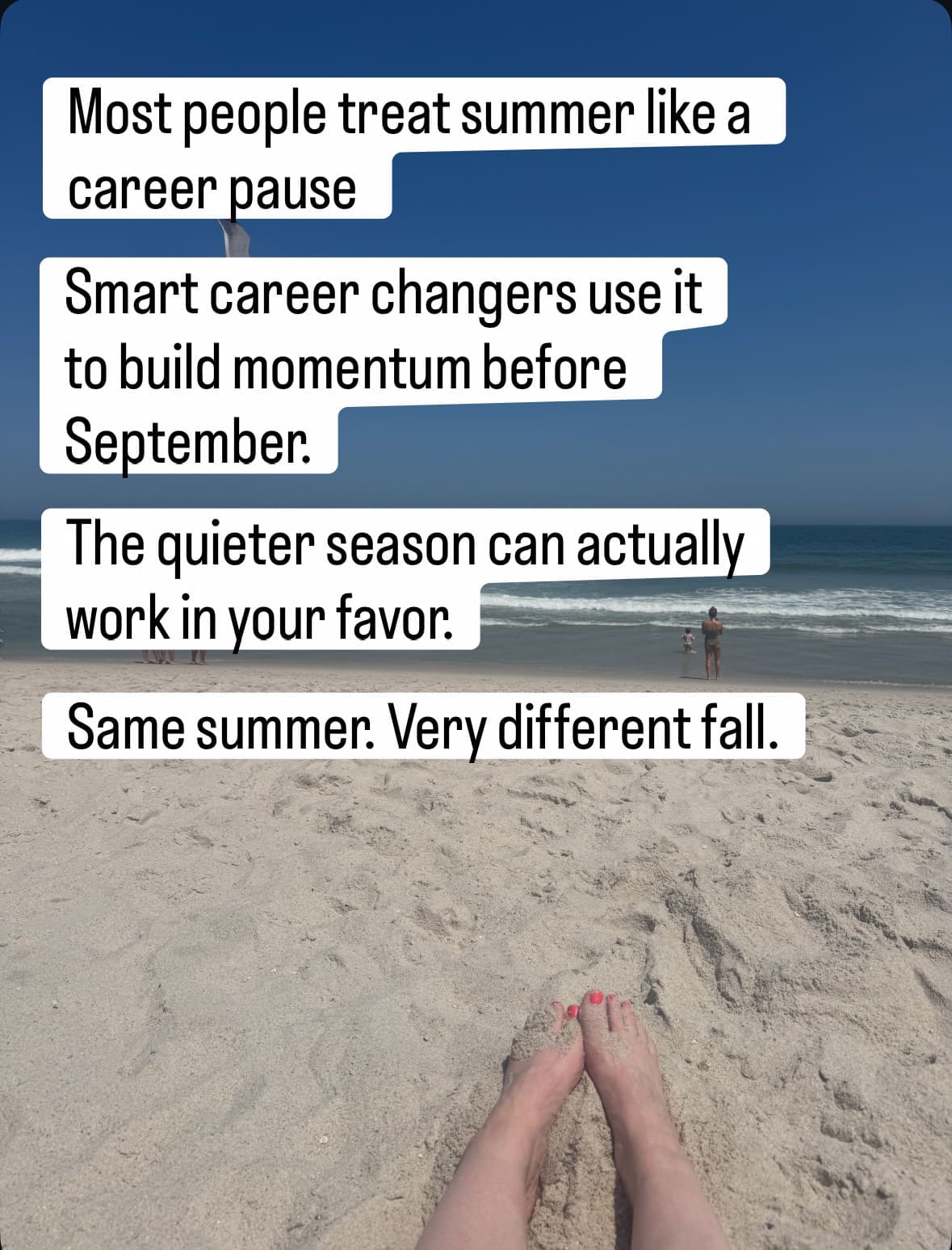

For a lot of people, summer becomes the unofficial pause button.
The kids are in different schedules. Work feels slower in some places and chaotic in others. People are away. Calendars are strange. It is easy to tell yourself, “I’ll get serious after Labor Day.”
And sometimes, that makes sense.
But if you are thinking about a career pivot, summer can also work in your favor.
There is usually less noise. Fewer people are actively reaching out. You may have more room to think, reflect, reconnect, and do the work that gets rushed when everything ramps back up in September.
A career pivot does not usually happen because you suddenly apply to 40 jobs.
It happens when you get clear about where you are going, understand what the market is asking for, connect your past experience to your next move, and start having the right conversations.
Here is a 6-week plan to help you use the rest of summer with more intention.
Week 1: Clarify your target
Before you rewrite your resume or start applying, get specific about where you may be headed.
Choose 2 to 3 role titles you are seriously exploring. Not 15. Not every interesting job you see. Just a small, focused set of possibilities.
Then look for patterns.
Ask yourself:
What skills keep showing up?
What industries or companies seem most aligned?
What level are these roles really asking for?
What problems would I be hired to solve?
Where does my current experience naturally connect?
This step matters because many career changers lose momentum by trying to position themselves for too many things at once. The more scattered the target, the harder it is to tell a clear story.
You are not locking yourself into one path forever. You are creating enough direction to move.
Week 2: Study the market
Once you have a few possible targets, study the language of the market.
Look at job posts, LinkedIn profiles, company pages, recruiter posts, and industry conversations. Pay attention to the words people use to describe the work.
You are looking for patterns, not perfection.
Start with a simple Google Jobs search.
Use this format:
[target role] jobs [industry] [location]
For example:
director of operations jobs healthcare New Jersey
Or:
program manager jobs higher education remote
Or:
marketing director jobs pharma New York City
This helps you see what roles are showing up across multiple job boards, not just one platform.
Then use Google to search LinkedIn job postings more specifically.
Use this format:
site:linkedin.com/jobs “[target role]” “[industry]” “[location]”
For example:
site:linkedin.com/jobs “director of operations” “healthcare” “New Jersey”
Or:
site:linkedin.com/jobs “program manager” “higher education” “remote”
You can also use Google to search LinkedIn profiles so you can see how people already in those roles are positioning themselves.
Use this format:
site:linkedin.com/in “[target role]” “[industry]”
For example:
site:linkedin.com/in “director of operations” “healthcare”
Or:
site:linkedin.com/in “program manager” “higher education”
As you review, make notes on:
Common keywords
Required skills
Preferred experience
Business problems mentioned
Titles that seem aligned
Gaps you may need to address
How people describe similar experience on LinkedIn
This is not about copying language. It is about understanding what the market values so you can position yourself more clearly.
Week 3: Update your career story
Now that you have a clearer sense of the market, start shaping your story.
This is where many people get stuck.
They either describe everything they have ever done, or they overcorrect and try to sound like they have already been doing the target role for years.
Neither works.
Your job is to build the bridge.
You want to show how your past experience connects to your next direction.
Start with your LinkedIn headline and About section. These are often easier to update before a full resume rewrite.
Ask yourself:
What do I want to be known for now?
What problems do I solve?
What experience gives me credibility for this next move?
What language will help people understand the connection?
What should I stop emphasizing because it pulls me backward?
For a pivot, your story should not erase your past. It should make your past make sense in relation to where you are going.
Week 4: Build your bridge
Career pivots are rarely built through applications alone.
You need conversations.
Make a list of 20 people who may be connected to your target direction.
Include:
Former colleagues
Alumni
Second-degree LinkedIn connections
People in your target roles
Recruiters in your target space
Friends of friends
Industry contacts
Professional group members
Do not overthink the list. You are not asking everyone for a job. You are creating a relationship map.
Then organize the list into three groups:
People I already know
People I can ask for perspective
People I want to learn from
This gives you a practical starting point instead of a vague “I should network more” goal.
Week 5: Start conversations
This is where momentum starts to build.
Send 3 to 5 thoughtful outreach messages per week.
The key is to avoid leading with, “Do you know of any openings?”
That puts pressure on the other person and usually does not lead to the best conversation.
Instead, try something more specific and lower pressure:
Hi [Name], I’m exploring a possible shift into [target area] and noticed your work in [specific area, company, or industry]. I’d value your perspective on how you see the space evolving and what skills seem most important right now. Would you be open to a brief conversation?
Or:
Hi [Name], I’m doing some research as I think through a possible career pivot into [target area]. Your background stood out because of your experience in [specific detail]. I’d be grateful for 15 minutes to ask a few questions about the work and how people typically move into this space.
Keep it simple. Keep it human. Keep it specific.
The goal is not to ask strangers to solve your career change.
The goal is to gather information, build relationships, and make your next step less theoretical.
Week 6: Tighten and apply with intention
By Week 6, you should have more clarity than you did at the start.
Now you can tighten your materials.
Update your resume for the target direction.
That means:
Leading with relevant positioning
Reframing experience around transferable value
Prioritizing accomplishments that support the pivot
Removing or minimizing details that pull you away from your target
Aligning keywords naturally
Making your story easy to understand
Then choose 5 to 7 roles that are genuinely aligned and apply with intention.
Not 50 random roles.
Not every job that looks vaguely interesting.
A smaller, stronger application set will usually teach you more than a scattered one.
Track what happens:
Which roles feel most aligned?
Where are you getting traction?
Where are you getting stuck?
What feedback are you hearing in conversations?
What gaps keep appearing?
This is how you refine the pivot instead of guessing.
Summer does not have to be a pause
You do not need to have everything figured out before you begin.
You need enough clarity to take the next practical step.
Summer can be the season where you stop circling the idea and start building the bridge.
By September, you could have:
A clearer target
A stronger career story
Updated LinkedIn positioning
A better understanding of the market
New conversations underway
A more focused resume
A smarter application strategy
That is a very different place to be than starting from scratch after Labor Day.
Same summer.
Very different fall.
Need help clarifying your next move?
If you are thinking about a career pivot, return to work, or next chapter move and you are not sure how to position yourself, this is the work I do with clients every day.
My process helps you clarify your direction, shape your story, and create career materials that connect where you have been with where you want to go next.
You can learn more about career coaching and resume support here: https://thejobgirl.com/resume-writing-nj
Or start by using this 6-week plan and taking the first step this week.
Frequently asked questions about making a career pivot in summer
Not necessarily. Summer can be slower in some industries because of vacations and shifting schedules, but that does not mean you should stop. It can be a strong time to clarify your direction, update your materials, reconnect with people, and prepare for fall hiring activity.
If you find aligned roles, apply. But do not rely only on applications. Use summer to strengthen your positioning, study the market, and build conversations so you are not starting from zero in September.
Start with a simple search like [target role] jobs [industry] [location]. Then look for patterns across the roles that appear. Pay attention to titles, keywords, qualifications, business problems, and recurring skills. The goal is not just to find openings. The goal is to understand how the market describes the work you want to move toward.
Use this search format: site:linkedin.com/jobs “[target role]” “[industry]” “[location]”. This helps you search LinkedIn job postings directly from Google and narrow your research by role, industry, and location.
Use this search format: site:linkedin.com/in “[target role]” “[industry]”. This can help you find people already working in your target space so you can study career paths, positioning, skills, and language.
Start by identifying 2 to 3 possible role directions and studying the patterns across those roles. Look at skills, keywords, industries, responsibilities, and people already doing the work. Clarity usually comes from active exploration, not waiting until you feel 100% certain.
For many people, LinkedIn is a good place to start because it helps you test and clarify your broader positioning. Your resume can then be tailored more specifically once your target direction is clearer.
Focus on quality over volume. Choose a smaller set of aligned roles where your background has a credible connection to the work. For this plan, 5 to 7 focused applications in Week 6 is a better starting point than sending dozens of scattered applications.

Rebecca Henninger is the founder of The Job Girl and a career strategist, executive resume writer, and personal branding expert for Directors, VPs, executives, and accomplished career changers. Based in Montville, New Jersey, she works with clients nationwide and brings deep expertise in pharma, biotech, life sciences, and complex corporate careers.


View comments
+ Leave a comment