

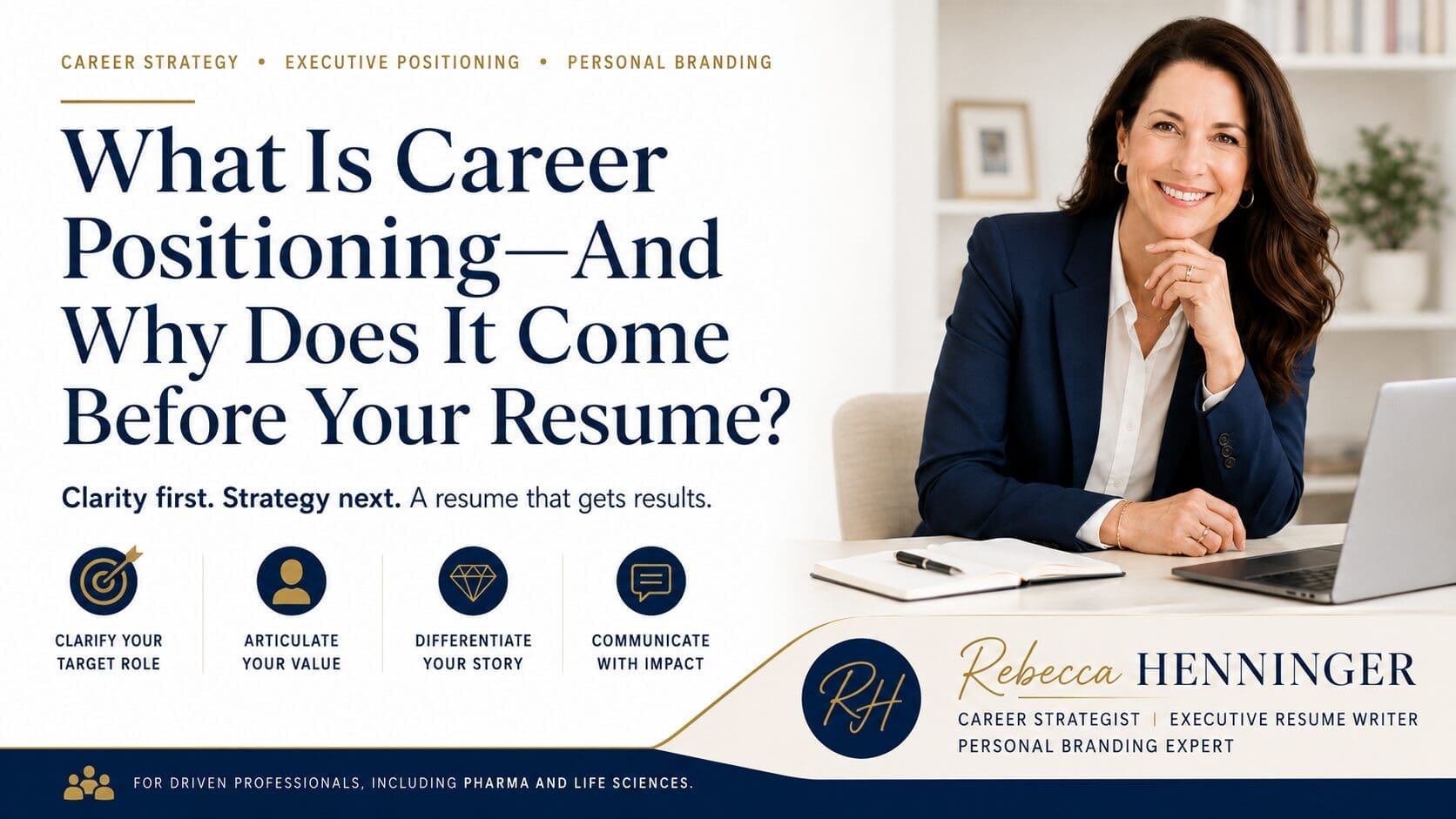

Career positioning is the process of defining where you fit, what you offer, and how your experience should be understood by the market.
It clarifies four things before you begin writing a resume or updating LinkedIn:
- The roles you should target
- The level at which you should be positioned
- The value you bring to an organization
- The story that connects your experience to what you want next
Resume writing communicates that strategy.
Career positioning creates it.
This distinction matters because many experienced professionals do not have a resume problem. They have a positioning problem that has followed them into their resume, LinkedIn profile, networking conversations, and interviews.
A Resume Documents Your Career. Positioning Interprets It.
A traditional resume update often begins with your existing document.
What should be rewritten?
Which bullets need stronger results?
What keywords should be added?
How should the page be formatted?
Those questions are important, but they come later.
Before deciding how to describe your experience, you need to know what the reader should conclude from it.
Are you a commercial strategist who can guide portfolio investment?
A scientific leader who translates evidence into organizational decisions?
An operator who brings discipline to complex, regulated environments?
A functional expert ready to step into broader enterprise responsibility?
Your career may support several interpretations. Career positioning determines which interpretation will be most credible, relevant, and valuable for the opportunities you are pursuing.
Without that decision, even a polished resume can feel broad, overcomplicated, or disconnected from the target role.
What Does a Career Positioning Strategist Do?
A career positioning strategist helps you make sense of your experience before turning it into career materials.
The work typically includes identifying your strongest role direction, clarifying your level and scope, defining your differentiators, selecting the right proof points, and creating language that can be used consistently across your resume, LinkedIn profile, interviews, networking, and professional bio.
The goal is not to manufacture a new identity.
It is to uncover the strongest, most relevant interpretation of the experience you already have.
As a career strategist, executive resume writer, and personal branding expert, this is where I begin with clients.
I work with driven professionals whose careers have become too complex for a straightforward resume update. Many are navigating a promotion, leadership transition, career pivot, return to work, or move into a new industry. I also specialize in supporting professionals across pharma, biotech, medical device, and life sciences.
The industry and circumstances may differ, but the central question is usually the same:
How should the market understand me now?
The Five Questions Career Positioning Must Answer
Strong positioning should give you clear answers to five practical questions.
1. What is your focus role?
A focus role is the primary position or closely related group of positions your search is designed around.
This does not mean you can only pursue one exact title. It means your experience needs a clear destination.
Trying to target strategy, operations, marketing, business development, program management, and chief of staff roles with one general resume usually weakens your candidacy across all of them.
A focused search makes it easier to determine:
- Which experience should lead
- Which accomplishments are most relevant
- Which capabilities require stronger proof
- Which opportunities fit your background
- Which roles may look attractive but are not aligned
Clarity is not restrictive. It prevents your strongest qualifications from getting buried.
2. At what level should you be positioned?
Job titles do not always reflect the true scope of someone’s work.
A director may already be operating at an executive-director level. A vice president in a smaller organization may need to recalibrate for a larger enterprise. Someone with an individual-contributor title may be influencing decisions across functions, regions, or business units.
Positioning should account for the real level of the work:
- Decision authority
- Organizational scope
- Strategic influence
- Financial or portfolio responsibility
- Cross-functional leadership
- Complexity of the problems solved
The goal is not to inflate your level. It is to make sure the market does not underestimate it.
3. Where do you create the most value?
Experience alone is not a value proposition.
A list of responsibilities tells people what you have done. Positioning helps them understand why it matters.
Your value may come from your ability to:
- Turn strategy into disciplined execution
- Bring order to complex operations
- Translate technical information for business stakeholders
- Identify the underlying problem before designing a solution
- Guide products, programs, or portfolios through critical decisions
- Align groups with competing priorities
- Recognize risk early and create a practical path forward
Strong positioning identifies the pattern behind your best work.
That pattern is often more useful than a long inventory of skills.
4. What makes your approach different?
Many candidates use the same language:
Strategic.
Collaborative.
Results-oriented.
Innovative.
Cross-functional.
These words are not wrong. They are simply too broad to create differentiation on their own.
Your differentiator is usually found in how you think and operate.
Perhaps you combine scientific depth with commercial judgment. Maybe you have moved between consulting and internal leadership roles, giving you the ability to diagnose an organization before recommending change. You may understand how decisions made in one function affect systems, teams, customers, or patients downstream.
The difference needs to be specific enough to believe and useful enough to matter.
5. What evidence supports the position?
A professional brand cannot rest on adjectives.
It needs proof.
That proof may include:
- A business or function you transformed
- A launch, program, or portfolio you advanced
- A difficult decision you helped an organization make
- A capability or operating model you created
- A risk you reduced
- A market or customer opportunity you identified
- A team or organization you guided through change
The strongest proof points demonstrate a repeatable pattern rather than isolated success.
Career Positioning vs. Resume Writing
Career positioning and resume writing are connected, but they are not the same service.
Career positioning determines:
- Your role direction
- Your professional narrative
- Your level
- Your differentiated value
- The evidence that should define your candidacy
Resume writing determines:
- How that strategy is organized
- How achievements are written
- How information is prioritized
- How keywords are integrated
- How the document is formatted and presented
You may need both.
The sequence is what matters.
Writing the resume before establishing the positioning often leads to multiple revisions because the underlying strategy keeps changing. Once the positioning is clear, decisions about the resume become more disciplined.
You know what belongs.
You know what does not.
You know what the opening section needs to communicate.
And you can evaluate every bullet against the role you are pursuing.
Why Experienced Professionals Often Struggle to Position Themselves
The longer your career becomes, the harder it can be to summarize.
You may have worked across several functions, inherited responsibilities outside your original role, supported multiple business models, or developed expertise that does not fit neatly into your current title.
You are close to the work, so everything can feel important.
That creates several common problems:
- The resume becomes a comprehensive career history
- Older experience receives too much space
- The most valuable work is buried in operational detail
- Multiple possible directions compete for attention
- The narrative reflects the current role rather than the desired one
- The candidate sounds capable but not clearly positioned
This is why a straightforward resume refresh is often insufficient for an experienced professional.
The challenge is not finding stronger verbs.
It is deciding what the career means.
Why Positioning Is Especially Important in Pharma and Life Sciences
Pharma and life sciences careers are rarely simple or linear.
A professional may work across therapeutic areas, assets, lifecycle stages, geographic markets, and complex matrix teams. Their impact may depend on influence rather than direct authority. Their work may connect scientific, clinical, regulatory, medical, access, operational, and commercial priorities.
The resume needs to communicate more than subject-matter expertise.
It must help the reader understand:
- Where you sit within the product or drug lifecycle
- How your function contributes to broader organizational outcomes
- What decisions you influence
- The scale and maturity of the assets, portfolios, or programs you support
- How you operate across a matrix
- Whether your experience signals readiness for broader responsibility
This is why I do not approach pharma resumes as a keyword exercise.
The language must be technically credible, but the positioning also needs to show scope, judgment, influence, and business relevance.
A strong pharma professional can still be overlooked when the narrative presents executive-level contribution as a list of functional activities.
Signs You Need Positioning Before a Resume Update
Career positioning should come first when:
- You are not certain which role to target
- You are considering several unrelated directions
- Your responsibilities have outgrown your title
- Your career has become broad or difficult to summarize
- You are moving from execution into strategy or leadership
- You are changing industries or functions
- You have strong experience but limited interview traction
- Your LinkedIn profile, resume, and interview story do not align
- Recruiters consistently approach you for roles below your desired level
- You struggle to explain what makes you different
A new document will not solve these issues unless the strategy behind it changes.
My Approach to Career Positioning
My work is guided by the CLEAR framework:
Clarity
Define the direction, role target, level, and decisions that will guide the search.
Language
Create clear language for your value, experience, differentiators, and professional story.
Execution
Translate the positioning into a resume, LinkedIn profile, networking strategy, interviews, and market activity.
Alignment
Make sure the opportunities you pursue fit your strengths, goals, values, and desired direction.
Reputation
Strengthen how others understand, remember, and speak about your professional value.
This framework allows the resume to function as part of a larger career strategy rather than as an isolated document.
Is Career Positioning the Same as Personal Branding?
Career positioning and personal branding overlap, but they are not identical.
Career positioning defines where you fit in the market and why you are a strong candidate for a particular type of opportunity.
Personal branding expands that strategy into the broader impression people form about you through your messaging, visibility, relationships, leadership style, and reputation.
Positioning is the decision.
Branding is how that decision becomes recognizable and consistent.
Both should be based on substance rather than self-promotion.
Do You Need a Career Coach, Career Strategist, or Resume Writer?
The right support depends on the problem you are trying to solve.
A resume writer may be the right choice when your target is already clear and you primarily need stronger career materials.
A career coach may be helpful when you need support evaluating options, building confidence, making decisions, or managing the job-search process.
A career positioning strategist is most useful when you need to clarify your direction, interpret your experience, establish your market narrative, and then translate that strategy into cohesive materials.
For complex transitions, these needs often overlap.
That is why my engagements combine positioning, personal branding, resume strategy, and career decision support based on the client’s goals.
Frequently Asked Questions About Career Positioning
Career positioning is the process of defining your target role, professional level, differentiated value, and market narrative before creating your resume, LinkedIn profile, or job-search messaging.
Positioning determines which experience belongs on the resume, what should be emphasized, and how the reader should interpret your background. Without it, a resume can be well written but unfocused.
Yes. Career positioning helps identify which capabilities transfer, where your experience is most relevant, and how to connect your past work to a new role or industry without overstating the fit.
No. It is valuable for experienced professionals at many levels, particularly those pursuing promotions, pivots, returns to work, industry changes, or more intentional career paths.
No. I work extensively with professionals across pharma, biotech, medical device, and life sciences, but I also support driven professionals in corporate environments who are navigating complex transitions, promotions, and leadership moves.
No. I work extensively with professionals across pharma, biotech, medical device, and life sciences, but I also support driven professionals in corporate environments who are navigating complex transitions, promotions, and leadership moves.
The Resume Should Be the Output, Not the Starting Point
Your next career move should not begin with a blank resume template.
It should begin with a clear understanding of:
- Where you are going
- Why that direction makes sense
- What you bring to the role
- What evidence supports your value
- What the market needs to understand about you
Once those decisions are made, the resume becomes easier to write and more effective.
Not because it contains more information.
Because it communicates the right information with a clear purpose.
Rebecca Henninger is the founder of The Job Girl and a career strategist, executive resume writer, and personal branding expert. She helps driven professionals clarify direction, position complex experience, and build cohesive career brands for promotions, pivots, leadership transitions, and competitive job markets. Her specialized work includes Director-, Executive Director-, VP-, and executive-level professionals across pharma, biotech, medical device, and life sciences.

Rebecca Henninger is the founder of The Job Girl and a career strategist, executive resume writer, and personal branding expert for Directors, VPs, executives, and accomplished career changers. Based in Montville, New Jersey, she works with clients nationwide and brings deep expertise in pharma, biotech, life sciences, and complex corporate careers.


View comments
+ Leave a comment