

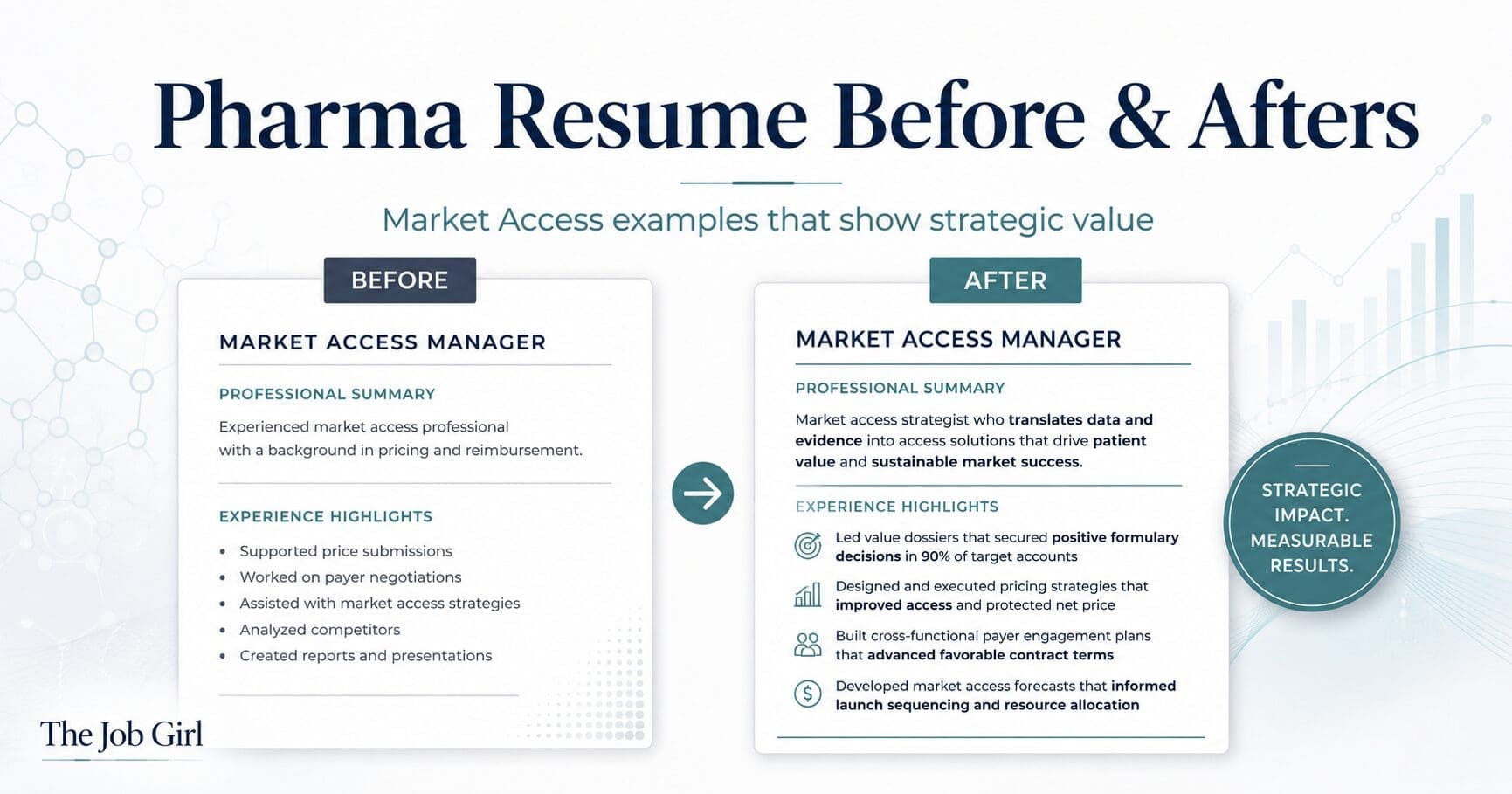

A lot of market access resumes sound like the person was near the strategy, not shaping it.
The experience is there. The scope is there. The cross-functional exposure is there.
But the resume reads like a list of responsibilities:
“Supported payer strategy.”
“Partnered with cross-functional teams.”
“Managed payer marketing materials.”
“Led access planning.”
“Collaborated with HEOR, medical, marketing, and field teams.”
None of that is necessarily wrong.
But it is incomplete.
For pharma and life sciences professionals in market access, marketing, commercial strategy, launch excellence, or patient services, the resume has to do more than document the function you supported. It has to show the business context, the decisions you helped shape, the stakeholders you aligned, and the value your work created.
That is the difference between a resume that says, “I was involved,” and a resume that says, “I understood the commercial problem and helped move the business forward.”
The problem with most pharma resume bullets
Many pharma resumes are too functional.
They explain what the person was assigned to do, but not what the work actually required.
For example:
Before:
“Responsible for payer strategy and access planning for product launch.”
This tells us the general lane.
But it does not tell us:
Was this pre-launch or post-launch?
Was the product specialty, rare disease, oncology, immunology, or primary care?
Was the access environment complex?
Were there coverage barriers?
Was the team building payer messaging, contracting strategy, field pull-through, or evidence planning?
Was the work tied to launch readiness, formulary positioning, account execution, or customer engagement?
Without that context, the bullet sounds generic.
A stronger version might be:
After:
“Shaped payer access strategy for a pre-launch specialty therapy, aligning pricing, contracting, field access, and commercial stakeholders around evidence needs, coverage barriers, and pull-through priorities.”
That bullet works harder.
It shows the function: payer access strategy.
It shows the context: pre-launch specialty therapy.
It shows the action: shaped strategy and aligned planning.
It shows the stakeholders: pricing, contracting, field access, commercial.
It shows the value: evidence needs, coverage barrier planning, and pull-through priorities.
That is resume positioning.
The formula for stronger pharma resume bullets
A stronger pharma resume bullet usually follows this structure:
Function + business context + strategic action + stakeholders aligned + outcome supported
Or, more simply:
What you worked on + why it mattered + what you moved
This formula helps shift the resume from task-based language to value-based language.
Instead of stopping at the assignment, you show the business reason behind it.
Instead of saying you “partnered with cross-functional teams,” you show what those partnerships enabled.
Instead of saying you “managed materials,” you show how those materials equipped field teams, supported payer conversations, or clarified value messaging.
Before and after: cross-functional access planning
Here is another common example.
Before:
“Partnered with cross-functional teams on market access initiatives.”
This is one of the most common resume phrases in pharma.
The problem is that it says almost nothing.
Cross-functional with whom?
On what kind of initiative?
To solve what problem?
To support which business priority?
A stronger version:
After:
“Led cross-functional access planning with marketing, medical, HEOR, finance, and field teams to translate payer insights into launch strategy, customer messaging, and execution priorities.”
Now the bullet has weight.
It shows the candidate was not just attending meetings. They were translating payer insight into decisions and execution.
That distinction matters, especially at the Director, Senior Director, and Executive Director level.
At that level, hiring leaders are not just looking for someone who can participate in cross-functional work. They want someone who can create alignment, sharpen strategy, and help teams make better decisions in complex commercial environments.
Before and after: payer marketing materials
Here is another example.
Before:
“Managed payer marketing materials.”
Again, this may be true. But it is too small.
It makes the work sound administrative when it may have required strategic judgment, agency management, legal/regulatory review, customer insight, message development, and field enablement.
A stronger version:
After:
“Developed payer-facing value communication tools that equipped account teams to address formulary decision drivers, access objections, and customer-specific evidence needs.”
This version tells us how the work was used.
It connects the deliverable to the field team, the customer conversation, and the payer decision environment.
That is the difference between describing an asset and explaining its commercial purpose.
Why this matters in pharma
Pharma is full of complex work that can sound deceptively simple on a resume.
“Launch planning” may involve indication sequencing, competitive readiness, market shaping, field preparation, advisory board insights, payer research, evidence gaps, and global-to-local adaptation.
“Market access strategy” may involve payer segmentation, pricing assumptions, contracting scenarios, affordability barriers, distribution considerations, account pull-through, and coverage planning.
“Commercial strategy” may involve portfolio prioritization, brand planning, channel strategy, forecasting, customer engagement, lifecycle opportunities, and executive decision support.
But when the resume uses vague phrases, the complexity disappears.
The candidate may have done strategic work, but the reader cannot see it.
And if the reader cannot see it, they cannot value it.
What senior pharma resumes need to show
For pharma professionals moving into bigger roles, especially Director-level and above, the resume should show more than functional exposure.
It should show judgment.
That means making the business context visible.
Was this a launch, relaunch, lifecycle expansion, competitive threat, access challenge, coverage recovery, LOE environment, or market entry?
It should show the decisions you influenced.
Did you shape payer strategy, evidence planning, segmentation, messaging, contracting, budget impact assumptions, pull-through priorities, field enablement, or customer engagement?
It should show the stakeholders you aligned.
Did you work with brand, medical, HEOR, legal, regulatory, finance, patient services, trade, field access, account management, global, regional, or agency partners?
It should show the outcome your work supported.
Did the work improve launch readiness, strengthen access positioning, clarify field execution, reduce barriers, expand coverage, improve customer engagement, or accelerate decision-making?
These are the details that turn a resume from a job description into a leadership story.
The key shift: from responsibility to impact
The biggest mistake I see is that candidates stop at responsibility.
They write:
“Responsible for launch planning.”
“Responsible for payer strategy.”
“Responsible for stakeholder engagement.”
“Responsible for brand planning.”
“Responsible for market research.”
But responsibility does not equal value.
A stronger resume answers a different set of questions:
What was happening in the business?
What problem needed to be solved?
What did you clarify, shape, lead, translate, align, or move?
Who needed to be brought together?
What became clearer, stronger, faster, or more executable because of your work?
That is where stronger positioning comes from.
A practical way to rewrite your own bullets
If you are looking at your resume and it feels too flat, start with one bullet and ask yourself five questions:
1. What was the business context?
Was this tied to launch, growth, access, lifecycle management, competitive pressure, transformation, or operational complexity?
2. What was the real problem?
Was the team trying to improve readiness, clarify strategy, address barriers, align stakeholders, support field execution, or make better decisions?
3. What did I actually move?
Did you shape the strategy, build the plan, translate insights, align functions, drive governance, create tools, or improve execution?
4. Who did I influence?
Which stakeholders, teams, markets, partners, agencies, or leaders were involved?
5. What changed because of the work?
Did the work improve visibility, readiness, alignment, decision quality, execution, coverage, engagement, or business performance?
Once you answer those questions, your resume bullet will almost always become stronger.
The takeaway
A stronger pharma resume does not just say what function you supported.
It shows the business problem, the judgment you brought, and the commercial value your work made possible. This is why strong resume writing starts with career positioning, not formatting
For market access professionals, that is especially important.
Because market access is not just “supporting commercialization.”
It is often where strategy becomes real.
It is where evidence, pricing, contracting, payer needs, field execution, and patient access all have to connect.
Your resume should make that visible.
Not by stuffing it with buzzwords.
Not by making the work sound bigger than it was.
But by showing the context, the complexity, the decisions, and the outcomes clearly.
That is what helps hiring leaders understand not only what you have done, but why it matters.
If your pharma resume reads more like a list of responsibilities than a clear story of your strategic value, it may be time to reposition it.
At The Job Girl, I work with pharma and life sciences professionals on resume and positioning support that translates complex experience into clear, credible positioning for the roles they want next.
Whether you are moving into a bigger commercial role, preparing for a market access leadership search, or trying to better articulate the value of your work, your resume should show more than what you managed. It should show what you moved.
Schedule a 30-minute CLEAR Positioning Call to discuss your next move
Frequently Asked Questions About Market Access Resumes
Pharma resumes often sound generic because they list responsibilities without explaining the business context, strategic decisions, stakeholders, or outcomes behind the work. A stronger resume shows not only what someone managed, but what they helped move forward.
A market access resume should include payer strategy, launch or lifecycle context, pricing and contracting exposure, cross-functional leadership, HEOR collaboration, field access alignment, payer messaging, pull-through planning, and the commercial outcomes supported by the work.
Use this formula: function + business context + strategic action + stakeholders aligned + outcome supported. In simpler terms, show what you worked on, why it mattered, and what you moved.
Instead of writing, “Responsible for payer strategy and access planning for product launch,” a stronger bullet would be: “Shaped payer access strategy for a pre-launch specialty therapy, aligning pricing, contracting, field access, and commercial stakeholders around evidence needs, coverage barriers, and pull-through priorities.”
Yes, when the metrics are accurate, meaningful, and relevant. But not every strong pharma bullet needs a number. Strategic work can also be shown through launch readiness, decision quality, stakeholder alignment, access positioning, field execution, or coverage improvement.
Most pharma resumes for mid-career and senior-level professionals are two pages. Executives, consultants, or candidates with extensive publications, speaking engagements, patents, or board work may need an executive CV or supplemental leadership profile.
A senior pharma resume needs to show judgment, scope, influence, and business impact. It should move beyond tasks and show how the candidate shaped strategy, aligned teams, influenced decisions, and supported commercial, access, operational, or portfolio outcomes.

Rebecca Henninger is the founder of The Job Girl and a career strategist, executive resume writer, and personal branding expert for Directors, VPs, executives, and accomplished career changers. Based in Montville, New Jersey, she works with clients nationwide and brings deep expertise in pharma, biotech, life sciences, and complex corporate careers.


View comments
+ Leave a comment