


Why do pharma and executive resumes fail to get noticed?
Pharma and executive resumes fail when they lack brand clarity. Without a clear role target and value story, even well-written resumes don’t signal relevance to hiring decision-makers.
Is formatting the problem?
Usually, no. In regulated, complex environments like pharma — and at the executive level — the issue is rarely layout, keywords, or bullet structure. The problem is clarity.
What’s missing?
Most stalled resumes don’t clearly answer three questions hiring leaders care about:
- What role is this person targeting?
- What kind of leader or operator are they?
- Where do they create the most value?
When those answers aren’t clear, the resume blends in — regardless of experience or credentials.
Most professionals come to me saying, “I need a new resume.”Why do pharma and executive resumes fail?
Pharma and executive resumes fail when they lack brand clarity. Without a clear role target and value story, even well-written resumes don’t signal relevance to hiring decision-makers.
Most professionals come to me saying, “I need a new resume.”
The resume feels like the problem because it’s tangible. It’s something you can fix.
But when a resume isn’t getting traction — especially in pharma or at the executive level — the real gap is clarity, not formatting.
Why Strong Backgrounds Still Don’t Get Noticed
I regularly see resumes with impressive scope, recognizable companies, and real responsibility.
Yet:
- Recruiters skim and move on
- Executive roles stall at the screen
- Applications disappear into silence
This usually isn’t because the resume is poorly written.
It’s because it’s unclear.
Unclear about the role being targeted.
Unclear about where the person creates the most value.
Unclear about how their experience should be interpreted.
When clarity is missing, resumes default to documenting experience instead of positioning value.
Why This Is Especially True in Pharma and Life Sciences
Pharma and life sciences roles are complex by design.
They’re specialized, heavily matrixed, and evaluated through scientific, regulatory, operational, and commercial lenses at the same time.
Hiring leaders aren’t just scanning for credentials.
They’re scanning for judgment, context, and fit.
If a resume doesn’t quickly answer what kind of leader or operator this person is, it blends in — even when the background is strong.
The Executive Resume Is a Branding Document
What is an executive resume?
An executive resume is a branding document, not a career summary. Its purpose is to position how a leader thinks, operates, and creates value — not to document every role they’ve held.
That doesn’t mean buzzwords or marketing language.
It means intentional positioning.
A strong executive resume makes clear:
- How you think
- How you operate
- What you’re known for
- Where you create leverage
Without that clarity, resumes become long, defensive, and hard to follow — not because of formatting, but because they’re trying to be everything at once.
Why Formatting and Keywords Aren’t the Fix
When resumes stall, people often reach for new templates, tighter bullets, or ATS optimization.
Those things can help at the margins.
They don’t solve a positioning problem.
You can’t optimize your way out of unclear strategy.
If the role target is fuzzy, the resume will be too.
If the value story is generic, the bullets will be too.
Hiring managers feel that immediately.
Why Clarity Comes Before Resume Writing
Why does clarity come before resume writing?
Clarity determines what belongs on a resume, what gets emphasized, and what gets removed. Without clarity, resumes become overloaded and unfocused, regardless of formatting or keywords.
Clarity answers practical questions:
- What role makes sense now?
- What’s the through-line in my experience?
- What problems do people consistently rely on me to solve?
Once those answers are clear, the resume gets simpler — not longer.
What Changes After Clarity
When clarity is in place:
- The resume writes faster
- LinkedIn aligns naturally
- Networking conversations feel grounded
- Recruiter screens improve
The resume stops feeling like a constant project and starts functioning as a strategic tool.
Why I Start With Clarity (And Always Have)
I started my career in marketing and advertising. Long before I wrote resumes, I learned how positioning works inside real organizations.
You don’t lead with everything you’ve ever done.
You lead with what matters to the decision-maker.
That lens is why I don’t treat resumes as documents to polish, but as strategies to define. Especially in pharma and at senior levels, where complexity is the norm, not the exception.
Clarity isn’t a “nice to have.”
It’s what allows strong professionals to be understood correctly.
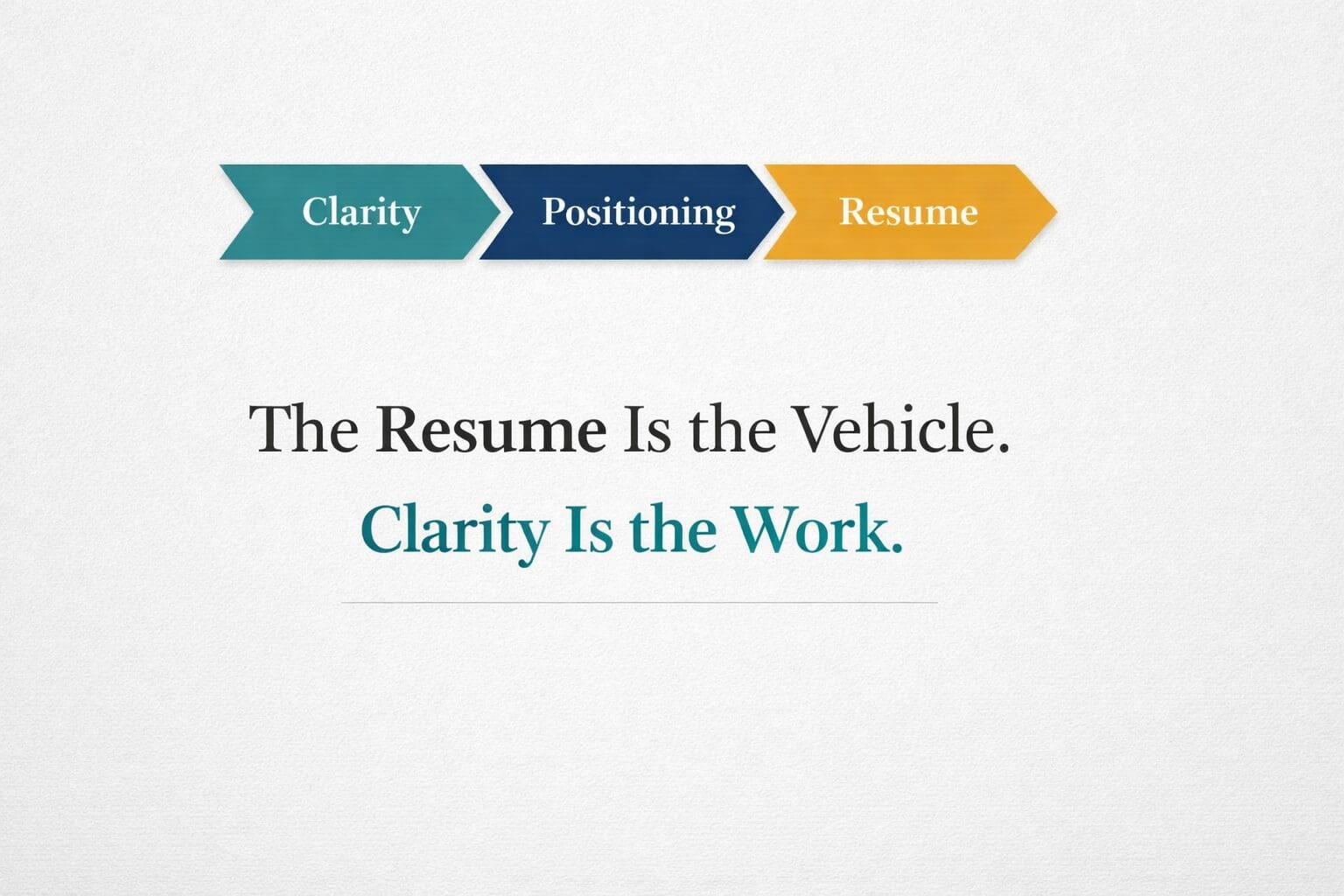
The Resume Is the Vehicle, Not the Work
If your resume feels “off,” the solution usually isn’t another rewrite.
It’s clarity about:
- Where you’re going
- How you create value
- What story your experience should tell
Once that’s clear, the resume becomes obvious.
Not because it’s flashy — but because it finally makes sense.
The resume feels like the problem because it’s tangible. It’s something you can fix.
But when a resume isn’t getting traction — especially in pharma or at the executive level — the real gap is clarity, not formatting.
Why Strong Backgrounds Still Don’t Get Noticed
I regularly see resumes with impressive scope, recognizable companies, and real responsibility.
Yet:
- Recruiters skim and move on
- Executive roles stall at the screen
- Applications disappear into silence
This usually isn’t because the resume is poorly written.
It’s because it’s unclear.
Unclear about the role being targeted.
Unclear about where the person creates the most value.
Unclear about how their experience should be interpreted.
When clarity is missing, resumes default to documenting experience instead of positioning value.
Why This Is Especially True in Pharma and Life Sciences
Pharma and life sciences roles are complex by design.
They’re specialized, heavily matrixed, and evaluated through scientific, regulatory, operational, and commercial lenses at the same time.
Hiring leaders aren’t just scanning for credentials.
They’re scanning for judgment, context, and fit.
If a resume doesn’t quickly answer what kind of leader or operator this person is, it blends in — even when the background is strong.
The Executive Resume Is a Branding Document
What is an executive resume?
An executive resume is a branding document, not a career summary. Its purpose is to position how a leader thinks, operates, and creates value — not to document every role they’ve held.
That doesn’t mean buzzwords or marketing language.
It means intentional positioning.
A strong executive resume makes clear:
- How you think
- How you operate
- What you’re known for
- Where you create leverage
Without that clarity, resumes become long, defensive, and hard to follow — not because of formatting, but because they’re trying to be everything at once.
Why Formatting and Keywords Aren’t the Fix
When resumes stall, people often reach for new templates, tighter bullets, or ATS optimization.
Those things can help at the margins.
They don’t solve a positioning problem.
You can’t optimize your way out of unclear strategy.
If the role target is fuzzy, the resume will be too.
If the value story is generic, the bullets will be too.
Hiring managers feel that immediately.
Why Clarity Comes Before Resume Writing
Why does clarity come before resume writing?
Clarity determines what belongs on a resume, what gets emphasized, and what gets removed. Without clarity, resumes become overloaded and unfocused, regardless of formatting or keywords.
Clarity answers practical questions:
- What role makes sense now?
- What’s the through-line in my experience?
- What problems do people consistently rely on me to solve?
Once those answers are clear, the resume gets simpler — not longer.
What Changes After Clarity
When clarity is in place:
- The resume writes faster
- LinkedIn aligns naturally
- Networking conversations feel grounded
- Recruiter screens improve
The resume stops feeling like a constant project and starts functioning as a strategic tool.
Why I Start With Clarity (And Always Have)
I started my career in marketing and advertising. Long before I wrote resumes, I learned how positioning works inside real organizations.
You don’t lead with everything you’ve ever done.
You lead with what matters to the decision-maker.
That lens is why I don’t treat resumes as documents to polish, but as strategies to define. Especially in pharma and at senior levels, where complexity is the norm, not the exception.
Clarity isn’t a “nice to have.”
It’s what allows strong professionals to be understood correctly.
The Resume Is the Vehicle, Not the Work
If your resume feels “off,” the solution usually isn’t another rewrite.
It’s clarity about:
- Where you’re going
- How you create value
- What story your experience should tell
Once that’s clear, the resume becomes obvious.
Not because it’s flashy — but because it finally makes sense.
Frequently Asked Questions
Pharma resumes fail when they lack clear positioning. In complex, regulated environments, hiring leaders look for clarity around role fit, judgment, and value—not just experience or credentials.
Yes. An executive resume is a branding document designed to position how a leader thinks, operates, and creates value. It is not a full career history.
Formatting matters only after clarity is established. Without a clear role target and value story, formatting and keywords won’t fix a resume that lacks focus.
Career clarity should come first. Clarity determines what belongs on the resume, what gets emphasized, and what gets removed.

Rebecca Henninger is the founder of The Job Girl and a career strategist, executive resume writer, and personal branding expert for Directors, VPs, executives, and accomplished career changers. Based in Montville, New Jersey, she works with clients nationwide and brings deep expertise in pharma, biotech, life sciences, and complex corporate careers.


View comments
+ Leave a comment